
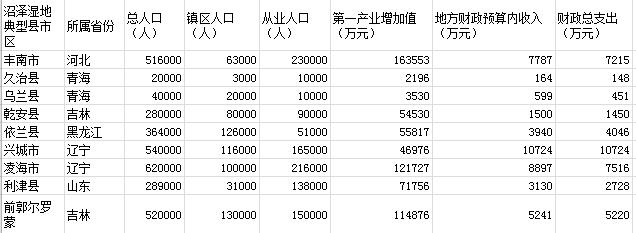
The purpose of this dataset is to count the economic and demographic factors in the typical wetlands of China in 1980s, 2000s and 2010s.
The time range of this dataset is 1980s, 2000s and 2010s.
The service object of this dataset is students and researchers who are engaged in natural geography, humanities and geography.
The data type of this dataset is relational database /Excel, which belongs to natural geography and human geography. The data collection area is a typical wetland area in China. The data are divided into county data.
The data are derived from the comprehensive survey of wetlands and their main eco-environmental benefits in China. The data have the following sources: Gansu county and city statistical yearbook 1980-1990 years, Hebei province county and city statistical yearbook 1980-1990 years, Heilongjiang province county and city statistical yearbook 1980-1990 years, Jilin province county and city statistical yearbook 1980-1990 years, Liaoning province county and city statistical yearbook 1980-1990 years, Inner Mongolia county and city statistical yearbook 1980-1990 Age, Qinghai province county and city statistical yearbook 1980-1990 years, Shandong province county and city statistical yearbook 1980-1990 years, Sichuan province county and city statistical yearbook 1980-1990 years, Tianjin statistical yearbook 1980-1990 years.
Processing methods: first, according to the relevant information of the map and other relevant information, the typical areas of China's marsh wetland are found, specific to the county-level cities, and then from the Chinese Yearbook, statistical data to check the social, population, economic and other economic elements of these counties and cities, collation and compilation.
The specific steps are as follows: first, the list of the specific counties (cities) of the typical areas of the marsh wetland in China and the search engines are used to find out the provinces which belong to the counties (cities). Next, look up the specific counties (cities) of the related provinces in the data entity, view the data content, and annotate and extract the data fields that the data set needs to reference. Because the data set is data of a certain age, not a year's data, so we need to summarize the data extracted in this era and calculate the average. Finally, the calculated average is compiled into files and recorded in the data table.
Note: this data collection is based on the data of social and economic factors, so in the process of extraction, only the total population, the number of town population, the number of employed people, the value of the first industry, the income of the local financial budget and the total expenditure of the finance are extracted, and the data of these elements are extracted and recorded.
Raw data is obtained from researchers in various colleges. The data in the hands of researchers are data compiled after years of investigation, investigation, and final compilation, so the data in this data set is more reliable than the data found in the search engine. The smallest granularity of data accuracy after processing is county (city) data. The quality control measures are self checking and checking by others.
 Institute of Geographic Sciences and Natural Resources Research, Chinese Academy of Sciences
 Northeast Institute of Geography and Agroecology, Chinese Academy of Sciences